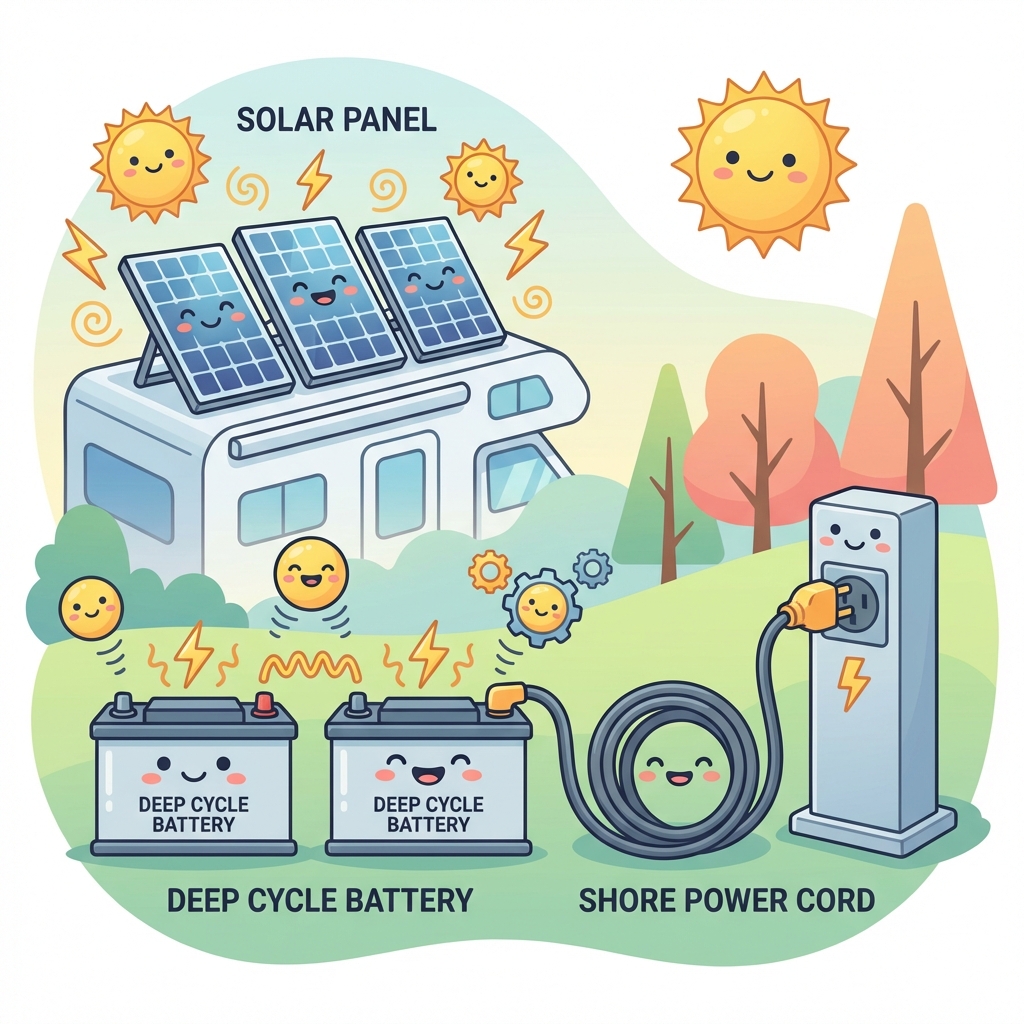
Understanding RV Electrical: 30 Amp vs 50 Amp
Master RV power management. Learn why 50A is actually 100A, and why you really need an EMS.
Electricity is the most confusing system in an RV. Getting it wrong can melt your adapter or fry your air conditioner. Here is the technical deep dive you need.
The Big Difference: 30A vs 50A
30 Amp Service
- Plug: 3 prongs (TT-30).
- Power: 120 Volts x 30 Amps = 3,600 Watts.
- Reality: One “Hot” leg. You can run one A/C unit and maybe the microwave. If you turn on a hair dryer, you will pop the breaker.
50 Amp Service
- Plug: 4 prongs (14-50R).
- Power: 120 Volts x 50 Amps x 2 Legs = 12,000 Watts.
- Reality: It is NOT just “20 more amps.” It is over 3 times the power. 50A service provides two separate 120V legs. You can run both A/C units, the electric water heater, the microwave, and likely a space heater all at once.
Adapting Down (Dogbones)
Yes, you can plug a big 50A rig into a 30A plug using a “Dogbone” adapter.
- The Limit: You are capped at 3,600 Watts total.
- Management: You must turn off leg-heavy appliances. Switch the water heater to Propane. Turn off the second A/C.
- Safety: Never use the cheap plastic “puck” adapters. They can melt. Use a heavy duty dogbone wire adapter.
Power Management: The Wattage Chart
Know what your appliances pull:
- Air Conditioner: 1,500W (Startup surge to 3,000W!)
- Microwave: 1,000w
- Electric Water Heater: 1,400W
- Coffee Maker: 1,000W
- Hair Dryer: 1,200W-1,500W
- Converter (Battery Charger): 200W-600W (Automatic)
Scenario: You are on 30A (3600W). You have the A/C running (1500W). Your battery charger is pulling 400W. Total = 1,900W.
- If you turn on the Microwave (1000W) -> 2,900W (Safe).
- If you turn on the Hair Dryer (1500W) -> 3,400W (Borderline).
- If the A/C cycles on while the Hair Dryer is running -> POP (Breaker trips).
Critical Safety Gear: The EMS
Do NOT buy a simple $50 “Surge Protector.” It only protects against lightning. You need an Electrical Management System (EMS) (Brands: Progressive Industries, Hughes Autoformer Watchdog).
What an EMS does:
- Low Voltage Protection: In summer, campground voltage often drops to 104V. This will burn out your A/C compressor motor in minutes. An EMS cuts power to save your appliance.
- Open Ground Detection: Saves you from “Hot Skin” (electrified RV frame).
- Reverse Polarity: Detects mis-wired pedestals.
Rule: Plug the EMS in first. If it shows an error, do not plug in your rig. Move sites.